Judydoll
Using Differences to Our Advantage
Chinese makeup brand Judydoll has built a reputation in Asia for playful colors, accessible pricing, and Gen Z-friendly aesthetics, but its global identity remains undefined. How can Judydoll position itself as the face of Chinese beauty culture for international audiences? Given the global popularity of K-Beauty, perhaps this could be used as a launching point for C-Beauty, showing audiences the styles and options that exist in the world of East Asian cosmetics.
Step 1: Douyin vs TikTok Challenge
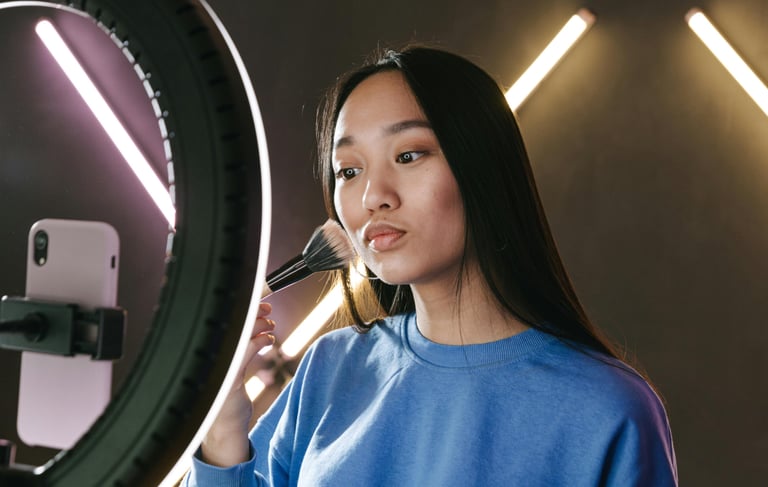
Let's reposition Judydoll as the defining face of C-Beauty by framing it in cultural contrast with K-Beauty. Rather than directly competing on product features, we dramatize the attitude difference between Chinese and Korean beauty styles. The campaign centers around the #DouyinVsTikTokLook challenge, where creators are asked to recreate two contrasting versions of themselves in a single video; the “TikTok Look” (soft-glam, glass-skin, neutral-toned, and gradient-lipped, representing the polished minimalism popularized by K-Beauty) and the “Douyin Look” (bold blush placement, sparkly eyes, sharp liner, and high-shine gloss), both achieved using Judydoll products.
Execution Strategy
We would collaborate primarily with East Asian diaspora beauty creators in North America since they can authentically speak to both cultures given the popularity of K-Beauty in the West. Alongside them, we’d onboard non-Asian beauty creators who enjoy exploring international trends, inviting them to “try the Douyin look” as a way to position Judydoll at the center of a global beauty conversation. The hashtag #DouyinVsTikTokLook would be mirrored across both apps, paired with the caption hook such as “Same face, different algorithm.” The transition between the two looks becomes the visual hook, with a custom remix soundtrack to create a seamless audio transition between the two. Early challenge videos from top creators would be boosted through paid ads to drive visibility and invite duets and remakes.
Why it works?
This campaign taps directly into the cultural moment: C-Beauty’s global emergence and Gen Z’s fascination with comparing aesthetic subcultures. By using the TikTok vs Douyin lens, we frame Judydoll not just as another brand, but as the visual language of Chinese youth culture and Judydoll's brand: confident, hyper-digital, and unafraid of excess. The side-by-side comparison also educates global audiences on C-Beauty’s distinct personality using an entertaining audio visual medium, instead of resorting to direct explanation. Most importantly, the campaign positions Judydoll as the brand at the center of the C-Beauty conversation while also being appropriate for K-beauty styles as well, advertising Judydoll as a brand that fuels creative inspiration despite cultural differences.
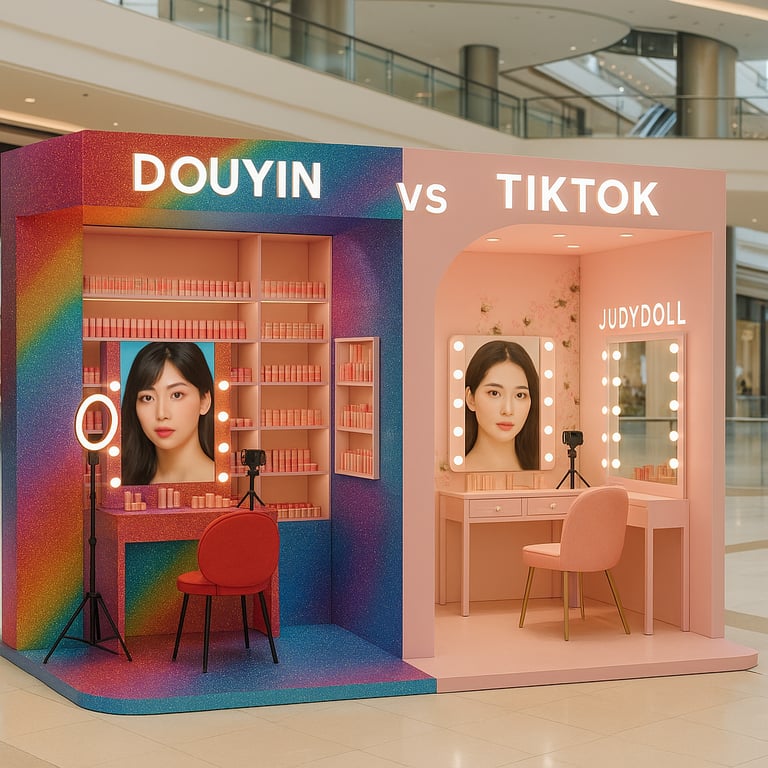
Step 2: Mirror-Mirror
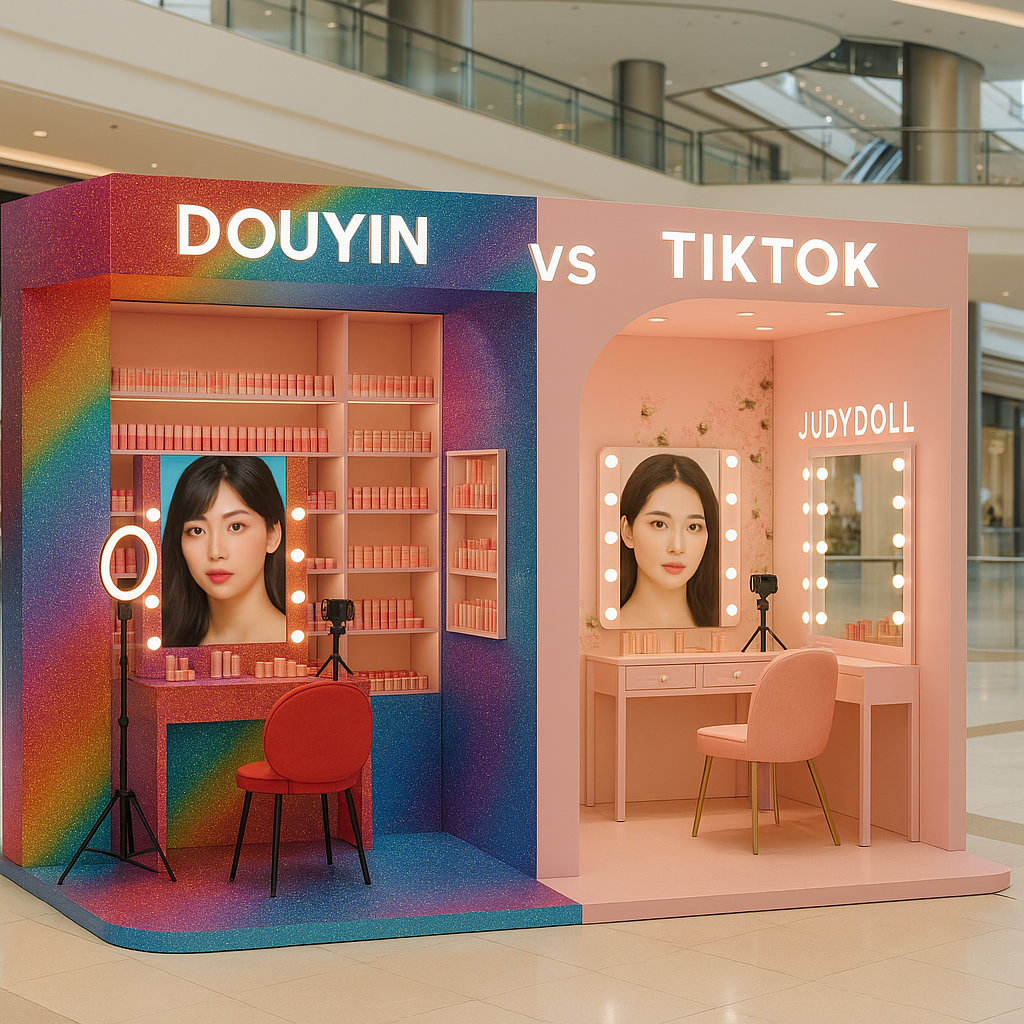
Turn the online comparison into a real-world cultural moment by letting audiences “step into the mirror” and experience both beauty worlds side by side. This stage converts social curiosity from the #DouyinVsTikTokLook challenge into active participation, encouraging people to explore how digital beauty aesthetics reflect cultural identity in physical spaces. We create pop up studios divided into two mirrored halves: one side styled in pastel minimalism echoing K-Beauty TikTok aesthetics, and the other drenched in bold colors representing C-Beauty’s Douyin look. Visitors can walk through, get quick makeovers from makeup artists using Judydoll products, and record their own short videos completing the transition on-site!
Execution Strategy
After the challenge has circulated online, we set up pop-up “Mirror Studios” in key diaspora cities like New York, Toronto, and San Francisco. We target large public areas where young East Asians are known to frequent in their free time, such as the Tangram Mall in Flushing, NY. To bridge the global campaign, we’d partner with creators who went viral during Step 1, inviting them to host meet-and-greets or film their own live “mirror transformation” content from the activation.
Additionally, or perhaps as an alternative plan, we could introduce a digital AR filter on TikTok and Instagram that would allow audiences to join virtually, toggling between the two aesthetics on their screen.
Why it works?
Step 1 is about seeing the difference between C-Beauty and K-Beauty, and Step 2 is about feeling it. The mirror metaphor ties perfectly into the Douyin vs TikTok concept: both platforms reflect cultures back to each other, but with different lighting, textures, and tones. By giving people a space to experience that contrast physically, we deepen the experience that the consumer has with the brand. Additionally, by targeting specific cities, we strategically ensure that we hit the largest segments of our most relevant demographic given the scope of the activation.
Connect
Your partner in multicultural influencer marketing solutions.
Explore
Engage
info@3rdculturesolutions.com
© 2025 Third Culture Solutions LLC. All rights reserved.